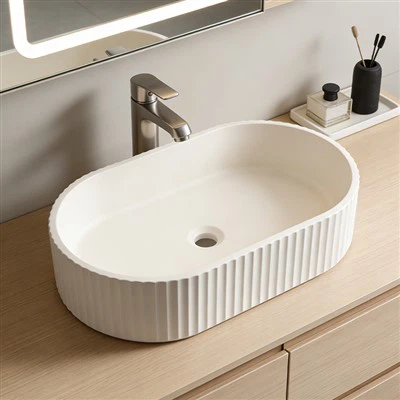
As a functional and artistic architectural component, the concrete oval tray's forming process must balance structural strength and precision. This article systematically explains the key process steps, including material selection, mold design, casting, and post-processing.
Material Proportioning and Pretreatment
The concrete raw materials require strict proportioning. High-strength Portland cement is typically used, along with well-graded medium-coarse sand and crushed stone (particle size 5-20mm). The water-binder ratio is controlled between 0.4-0.45 to ensure fluidity and density. To improve surface durability, water-reducing agents and mineral admixtures (such as fly ash) can be added. A non-oily, environmentally friendly release agent should be used to avoid residue that could affect concrete strength.
Mold Design and Fabrication
The oval tray's curved surface requires high-precision molds. Commonly used processes include fiberglass molds or silicone soft molds. The former uses 3D modeling and CNC machining of a master mold, which is then reproduced into a heat-resistant and deformation-resistant mold. The latter is suitable for small-batch, flexible production. The mold's inner wall should be polished to ensure smooth demolding, and vent holes should be provided to prevent air bubbles.
Casting and Curing Process
The concrete is poured in layers, with a base layer of concrete poured and vibrated to compactness. The concrete is then gradually filled to the edges of the oval, using a flexible vibrator to eliminate internal voids. For larger pallets, reinforcing mesh is recommended to enhance flexural strength. Edges and corners should be trimmed before initial setting. After final setting, the concrete should be covered with film for moisture retention and cured for 7-14 days at an ambient temperature of 15-25°C.
Surface Treatment and Post-Processing
After demolding, the blank is ground and polished. Local imperfections can be repaired with epoxy resin. High-end products can be coated with a penetrating protective coating to enhance stain resistance and weather resistance. For desired color effects, mineral pigments can be added to the concrete or dry-sprayed for color.
This meticulously controlled process enables the application of concrete oval pallets in architectural landscapes, high-end furniture, and other fields, balancing aesthetic value with structural reliability.